I know I am a little behind (10 days), some would say far behind. Yesterday I found out that Google Street View is now available for Phnom Penh! It is something that makes happy anyone who cares for this country. We are happy to see the very fast growth and development of this place.
Naturally, the first thing I did once had this information, was going to see how our center looks like in the eyes of Mr. Street View. I didn't expect the new light-box-sign we placed this week to be there although I was bothered by the old torn one. But I was happy to find out that the capturing took place shortly after we painted the outside.
My colleague from HCMC, Vietnam, Rabbi Menachem Hartman, came to open his Chabad center 8 years ago escorted by a filming team sent by a famous TV channel in Israel. I can tell you from my own experience that the first few weeks are exceptionally challenging. You can see it in the documentary that came out “Gut Shabbos Vietnam" in which Rabbi Menachem and his wife
are sometimes caught in moods that are far from hopeful. I once asked him how was he able to handle the cameras and the upcoming exposure in such sensitive time. He said he wished he would have them on for longer. Working while a camera is on you, he said, makes you work much better than otherwise...
There is much that one can learn from it. The first thing that comes to my mind is the massive gap between what I can potentially do in a day and what I actually do, even in a day that I consider very productive...
Once you think about it, the camera is actually there. In the Ethics of the Fathers (2, 1) it says: “Contemplate three things and you will not come to the hands of transgression: Know what is above from you: a seeing eye, a listening ear, and all your deeds being inscribed in a book".
At a large gathering many decades ago the Rebbe mentioned that the concept of video cameras visualizes the above theory. The video camera enables someone to see what took place before. I think that the development of
the video camera and its massive use today, enabled this idea to be visualized even by slow people like me. Today, in each and every corner you go, you may be recorded.
Not only that, but also “all your deeds being inscribed in a book". If only I knew that the ripped sign will be showing on Street View, I would have ran to change it long ago...
The cameras are on. It's not only shooting but also recording. Let's do it right!
Shabbat Shalom,
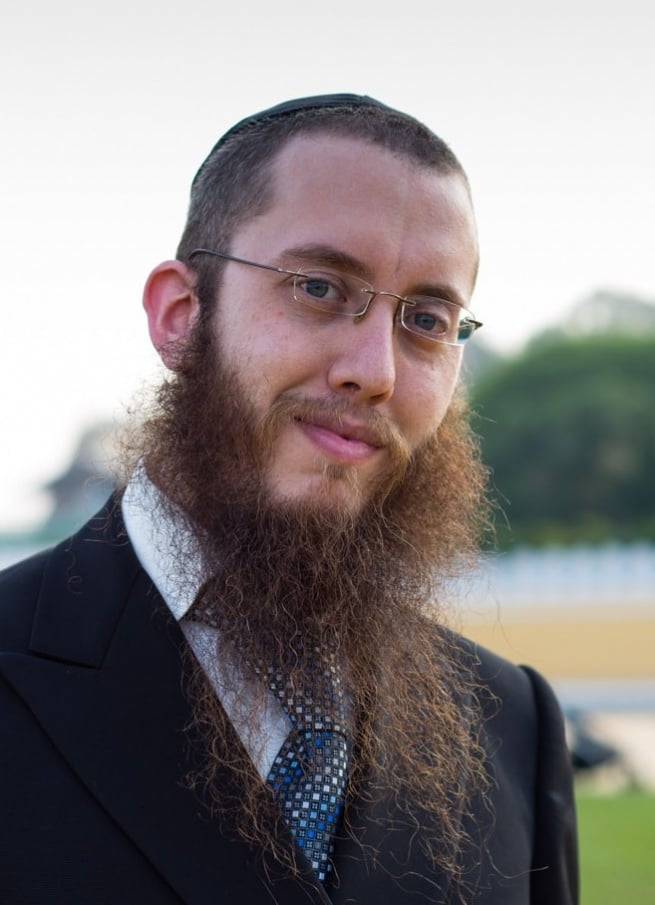
Rabbi Bentzion Butman
P.S. There is a large building and construction exhibition this coming week at Diamond Island (Wednesday to Friday, 10-12 September). It was brought to my attention that a Jewish company dealing with solar energy solutions named Star 8 Solar is presenting at booth no. c377/ba.07. If you intend to go, please stop by and check it out.
Candle lighting time in PP is 5:50. Shabbat ends in 6:45.

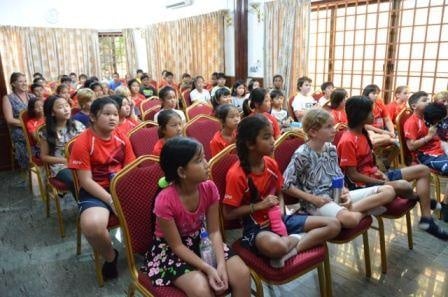 100 students from grade
4-5 of International School of Phnom Penh have visited the Jewish Center as part of their project exploring religions.
100 students from grade
4-5 of International School of Phnom Penh have visited the Jewish Center as part of their project exploring religions.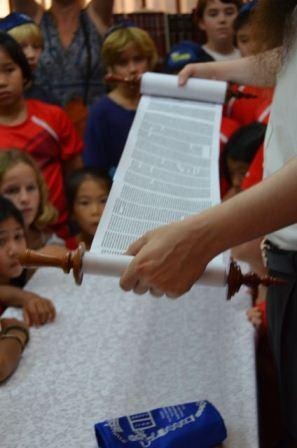
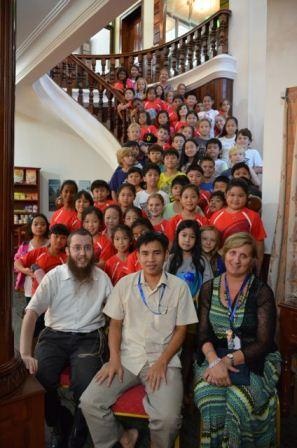 The students
came over in two groups which enabled us to give much time for questions. The students have expressed high interest in our traditions.
The students
came over in two groups which enabled us to give much time for questions. The students have expressed high interest in our traditions.